



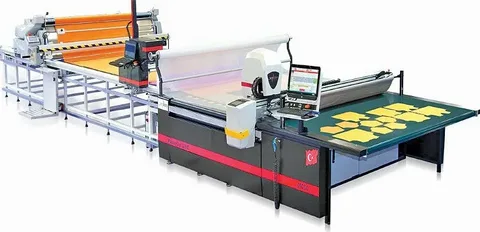
The textile and apparel industry has always been a marriage of craftsmanship and technology. From hand scissors and manual pattern laying in the early 20th century to today’s fully automated production lines, the single most critical step that determines quality, speed, and profitability has remained the same: cutting the fabric accurately and efficiently. This is where modern Fabric cutting equipment has undergone one of the most dramatic transformations in manufacturing history, with the digital cutting machine emerging as the clear frontrunner in contemporary garment, upholstery, technical textile, and fashion production facilities worldwide.
The Historical Journey of Fabric Cutting Equipment
Before the 1950s, fabric cutting was almost entirely a manual process. Skilled workers used straight-knife machines, band knives, or even electric hand cutters to separate plies of fabric laid on long tables. While these methods allowed for reasonable precision, they were slow, labor-intensive, and carried a high risk of human error. A slight deviation in angle could ruin dozens of plies and hundreds of dollars worth of material in seconds.
The introduction of computer numerically controlled (CNC) technology in the late 1970s and 1980s marked the first major leap forward. Early automated cutters used vacuum tables to hold multiple layers of fabric and moved a reciprocating knife along programmed paths. These machines dramatically increased throughput and consistency, but they still had limitations: high initial cost, complex mechanical maintenance, and the need for physical metal dies or templates for certain operations.
The Rise of the Digital Cutting Machine
The true revolution began in the early 2000s with the commercial maturation of the Digital cutting machine. Unlike its predecessors that relied primarily on knives (straight, reciprocating, or rotary), the modern digital cutter is a multi-tool platform capable of employing oscillating knives, drag knives, driven rotary wheels, pneumatic wheels, creasing wheels, and even laser or ultrasonic modules depending on the material.
Today’s flagship digital cutting systems from manufacturers such as Lectra (Gerber), Zünd, Eastman, Bullmer (Kurz), Kongsberg, and others integrate several breakthrough technologies:
- High-resolution projection systems that display nesting directly on the fabric
- Automatic markerless pattern matching using high-speed cameras and AI
- Real-time vacuum zoning that adjusts suction only where material is present
- IoT connectivity and Industry 4.0 integration for live production monitoring
- Advanced nesting algorithms that routinely achieve 3–7 % higher material yield than the best human marker makers
Key Advantages of Modern Digital Cutting Machines
1. Unmatched Material Efficiency
A traditional straight-knife or die-cutting operation typically achieves 80–87 % material utilization. State-of-the-art digital cutting machines regularly push utilization beyond 92 %, and in some cases 95 %, on striped, plaid, or printed fabrics thanks to vision-based matching and dynamic nesting. For a medium-sized factory cutting 200,000 meters of fabric per month, that 5–8 % improvement translates directly into tens or even hundreds of thousands of dollars in annual savings.
2. Dramatic Labor Reduction
Where manual spreading and cutting might require 8–12 workers per cutting table, a single automated digital cutting system can be operated by one or two technicians. In high-wage countries, this often means payback periods of 12–24 months even for expensive systems costing $400,000–$800,000.
3. Flexibility and On-Demand Production
One of the biggest limitations of traditional fabric cutting equipment was the time and cost involved in creating and storing metal dies. Digital cutters eliminate dies completely. Changing from a men’s shirt program to children’s dresses or automotive seat covers can take minutes instead of days. This agility is the cornerstone of fast fashion, mass customization, and make-to-order business models.
4. Superior Cut Quality and Reduced Fraying
Oscillating knives running at 12,000–18,000 strokes per minute combined with ultrasonic or laser modules produce sealed edges on synthetic fabrics, virtually eliminating fraying during subsequent handling and sewing. This is particularly valuable in technical textiles, sportswear, lingerie, and filtration media.
5. Integration with Digital Workflows
Modern digital cutting machines sit at the heart of end-to-end digital pipelines. 3D design files created in Browzwear, CLO, or Optitex flow seamlessly through automated marker-making software (often using AI-based nesting engines) and arrive at the cutter as optimized, ready-to-cut jobs—zero paper patterns, zero manual intervention.
Applications Beyond Traditional Apparel
While garment manufacturing remains the largest segment, the versatility of today’s digital cutting machine has opened entirely new markets:
- Automotive & aerospace: cutting carbon fiber prepreg, leather, Alcantara, acoustic insulation
- Upholstered furniture: precise cutting of patterned fabrics with flawless matching across seams
- Composites: multi-layer cutting of fiberglass, Kevlar, and prepreg materials
- Signage and packaging: soft signage, foam boards, and corrugated materials
- Medical and protective gear: disposable gowns, masks, and advanced wound dressings
- Footwear and bag manufacturing: leather, synthetic leather, and multi-layer assemblies
Choosing the Right Fabric Cutting Equipment in 2025
When evaluating new fabric cutting equipment, decision-makers should consider:
- Maximum cutting height (50–130 mm compressed is common)
- Toolhead configuration (single vs. dual beam, number of modular tools)
- Conveyor vs. static table (conveyor for roll-fed continuous operation)
- Vision system capabilities (defect mapping, print distortion compensation, stripe/plaid matching)
- Software ecosystem and CAD compatibility
- Service network and spare-parts availability in your region
- Energy consumption and noise levels (important for 24/7 operation)
The Future: AI, Robotics, and Full Autonomy
The next frontier is already visible. Manufacturers are integrating collaborative robots (cobots) that automatically unload cut pieces and sort them by size or bundle. Artificial intelligence is moving beyond nesting optimization into predictive maintenance, automatic knife wear compensation, and real-time production scheduling based on downstream sewing capacity.
Some factories in China and Turkey are already running “dark cutting rooms” where a single digital cutting line operates 22+ hours per day with only periodic human oversight for material loading and quality checks.
Conclusion
The evolution from manual shears to the sophisticated digital cutting machine represents one of the clearest examples of digital transformation in traditional manufacturing. Companies that continue to rely on outdated fabric cutting equipment face an almost insurmountable competitive disadvantage in material cost, labor efficiency, and responsiveness to market demands.
Investing in a modern digital cutting solution is no longer a luxury reserved for the largest brands—it has become a fundamental requirement for any serious player in apparel, technical textiles, or soft composites who intends to remain profitable and relevant through the 2030s and beyond.